Heavy or Light: Can Visualization help to Identify Thinning Frequency and Intensity?
Effect of Thinning on Volume Production in Birch and Scots Pine
Forestry
ggplot2
Data Visualization
Author
Olamide Adu
Published
April 10, 2025
This post aims to visualize the development of two species: Birch (Betula pubescens) and Norway spruce (Picea abies). The visualization would give insight into what type of thinning operation has been carried out.
Pine Plantation. Photo by Simon Rizzi - Pexels.com
I will answer the following questions using graphs:
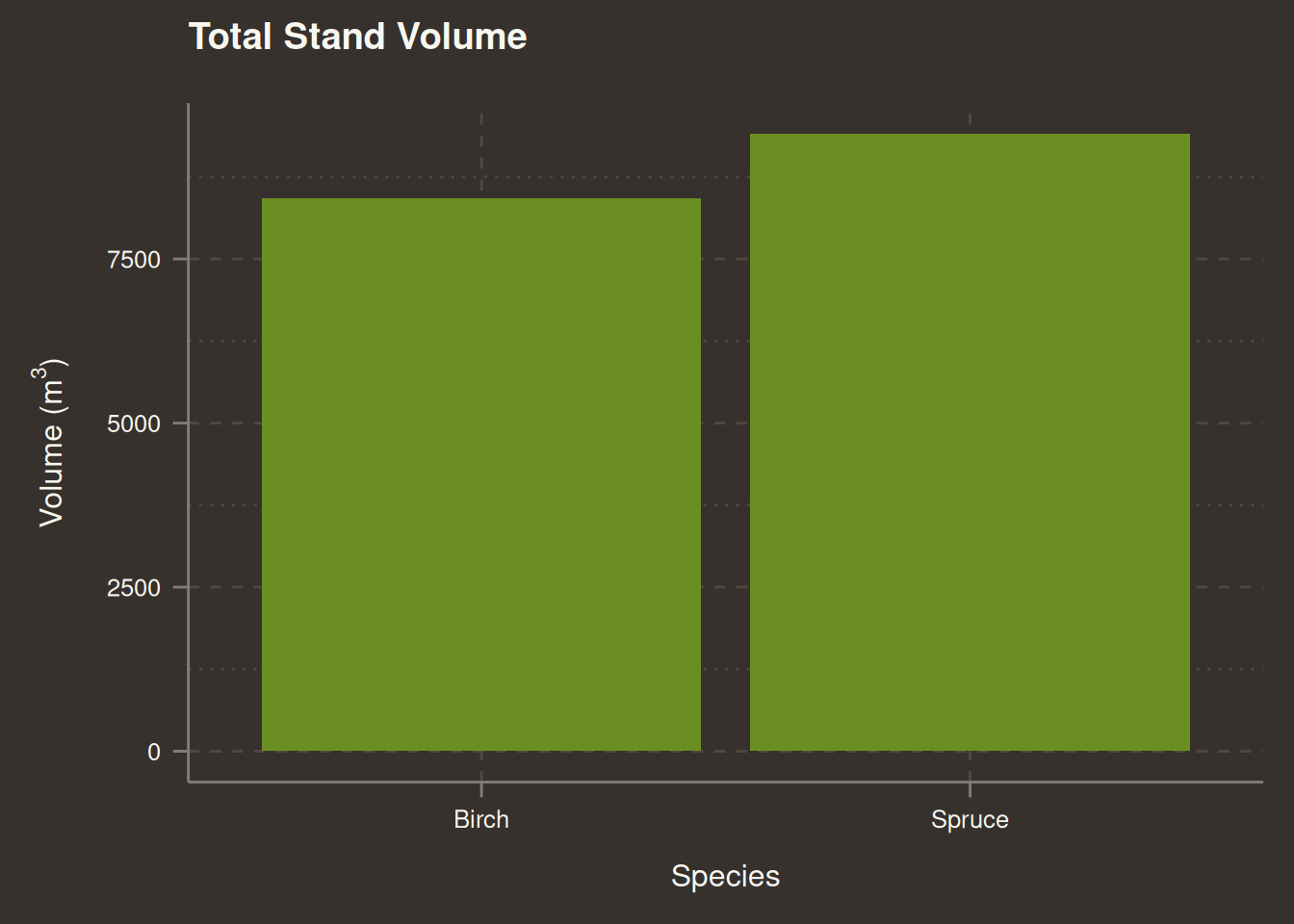
What is the total volume for each species
How many thinnings were made
What is the total yield (easy to mistake, but it’s different from total volume)
Warning: The `size` argument of `element_line()` is deprecated as of ggplot2 3.4.0.
ℹ Please use the `linewidth` argument instead.
ℹ The deprecated feature was likely used in the ggthemr package.
  Please report the issue to the authors.
Warning: The `size` argument of `element_rect()` is deprecated as of ggplot2 3.4.0.
ℹ Please use the `linewidth` argument instead.
ℹ The deprecated feature was likely used in the ggthemr package.
  Please report the issue to the authors.
To get a high-level summary of the data, I will use skimr (This should help better under stand the data).
Show the code
skimr::skim_without_charts(std_tbl)
Table 1: Data Summary
Data summary
Name
std_tbl
Number of rows
50
Number of columns
9
_______________________
Column type frequency:
numeric
9
________________________
Group variables
None
Variable type: numeric
skim_variable
n_missing
complete_rate
mean
sd
p0
p25
p50
p75
p100
site
0
1
3.50
2.53
1.00
1.00
3.50
6.00
6.00
age
0
1
65.00
36.42
5.00
35.00
65.00
95.00
125.00
stdens
0
1
1124.47
594.83
340.90
540.08
943.40
1675.30
2018.60
ba
0
1
30.31
12.47
0.08
25.31
32.86
38.58
49.11
stand_vol
0
1
336.60
181.81
0.60
206.70
367.90
462.15
648.40
harv_vol
0
1
13.65
47.93
0.00
0.00
0.00
0.00
225.92
mor_vol
0
1
6.35
5.94
0.00
2.83
4.48
8.12
24.32
spruce_dgv
0
1
18.90
18.41
0.00
4.99
11.59
33.67
55.85
birch_dgv
0
1
12.17
9.21
0.00
6.45
9.71
19.86
28.33
From Table 1, we can see that there are no missing data (n-missing = 0 and complete_rate = 1).
There are some variables that are not numerical but are categorical variables coded as numbers. Section 1.1 shows that site 1 represents Spruce and site 6 Birch. I will create a new variable that holds a factor of the species.
Show the code
std_tbl <- std_tbl |>mutate(species =case_when( site ==6~"Birch", site ==1~"Spruce" ),species =factor(species),.after = age )
Total Volume Estimation
To estimate the total volume, we need to sum up all volume data in the data stand_vol, harv_vol, and mor_vol
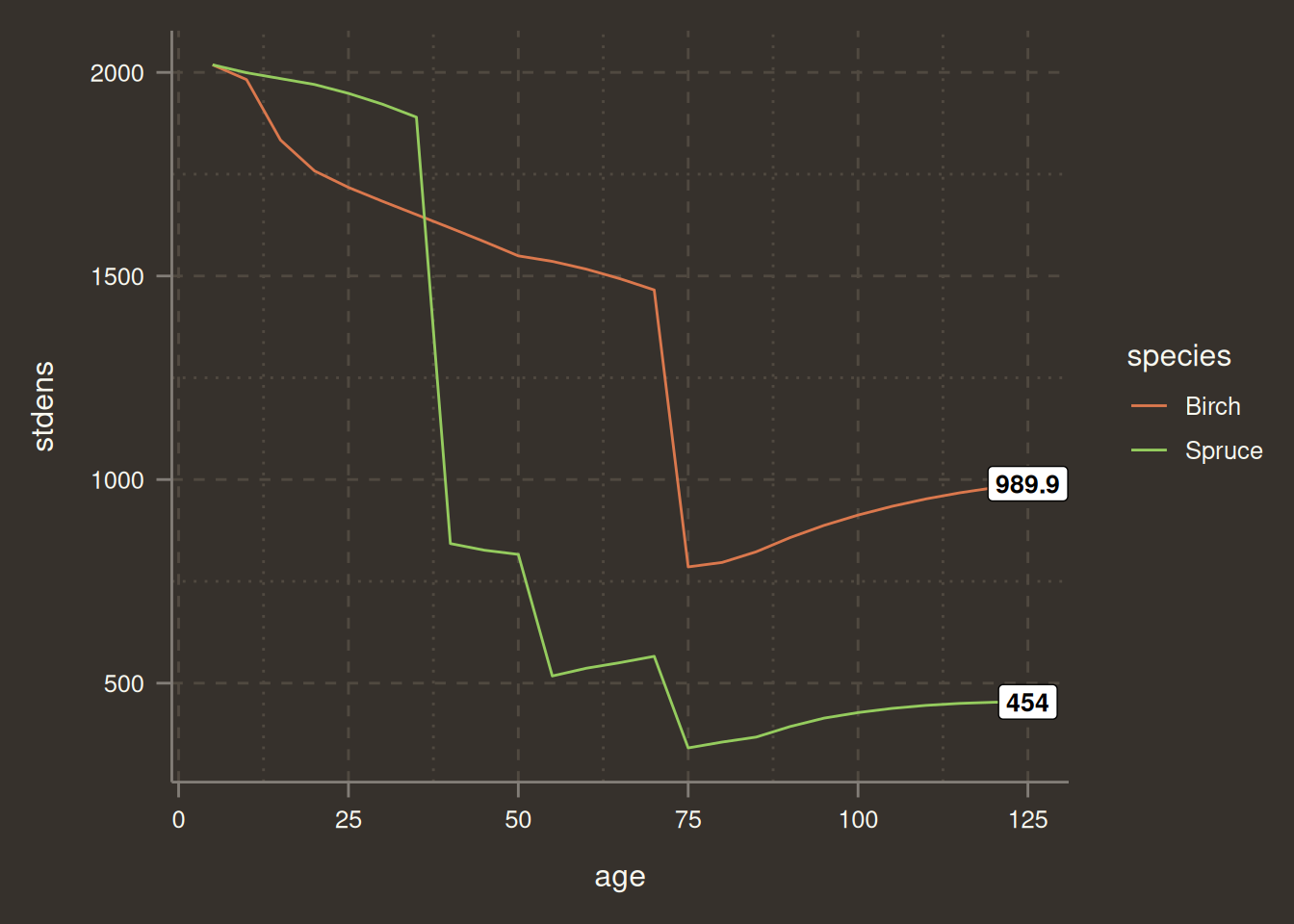
If we look at Figure 2, we see that both species had a planting density of 2000 st/ha and had several interventions with density at 125 years old at 989.9 st/ha for Birch and 454 st/ha for Spruce. This confirms that harvesting/thinning has been done at certain points or mortality has occurred in the stand
Warning: The `scale_name` argument of `discrete_scale()` is deprecated as of ggplot2
3.5.0.
Figure 2: Stand density trend over time
Thinning Investigation
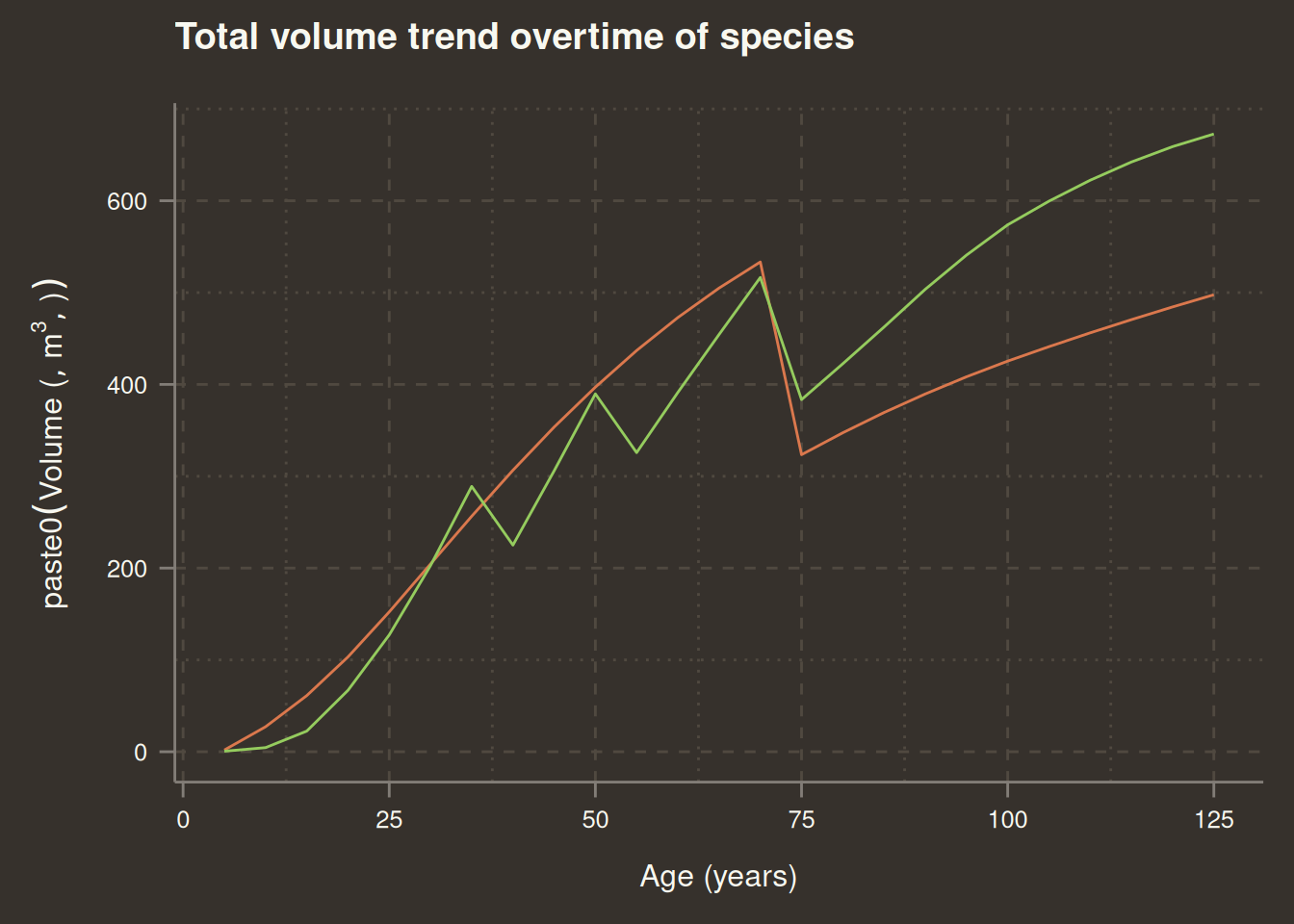
Plotting total volume against age should show the trend of stand development; any significant dip in development is where a thinning operation has occurred. Figure 3 shows that there’s been a single thinning in the Birch stand, while we have three thinnings in the Spruce stand. Are the thinnings heavy or not? We can’t say at the moment. Let’s move on to estimate the yield for both stands, then we will answer this question later.
<ggproto object: Class FacetWrap, Facet, gg>
    attach_axes: function
    attach_strips: function
    compute_layout: function
    draw_back: function
    draw_front: function
    draw_labels: function
    draw_panel_content: function
    draw_panels: function
    finish_data: function
    format_strip_labels: function
    init_gtable: function
    init_scales: function
    map_data: function
    params: list
    set_panel_size: function
    setup_data: function
    setup_panel_params: function
    setup_params: function
    shrink: TRUE
    train_scales: function
    vars: function
    super:  <ggproto object: Class FacetWrap, Facet, gg>
Figure 3: Trend of Volume. Birch has been thinned once, while Spruce was thinned three times.
Total Yield Estimation
To estimate the total yield, we evaluate the cumulative volume removed from the forest, then add it to the standing volume.
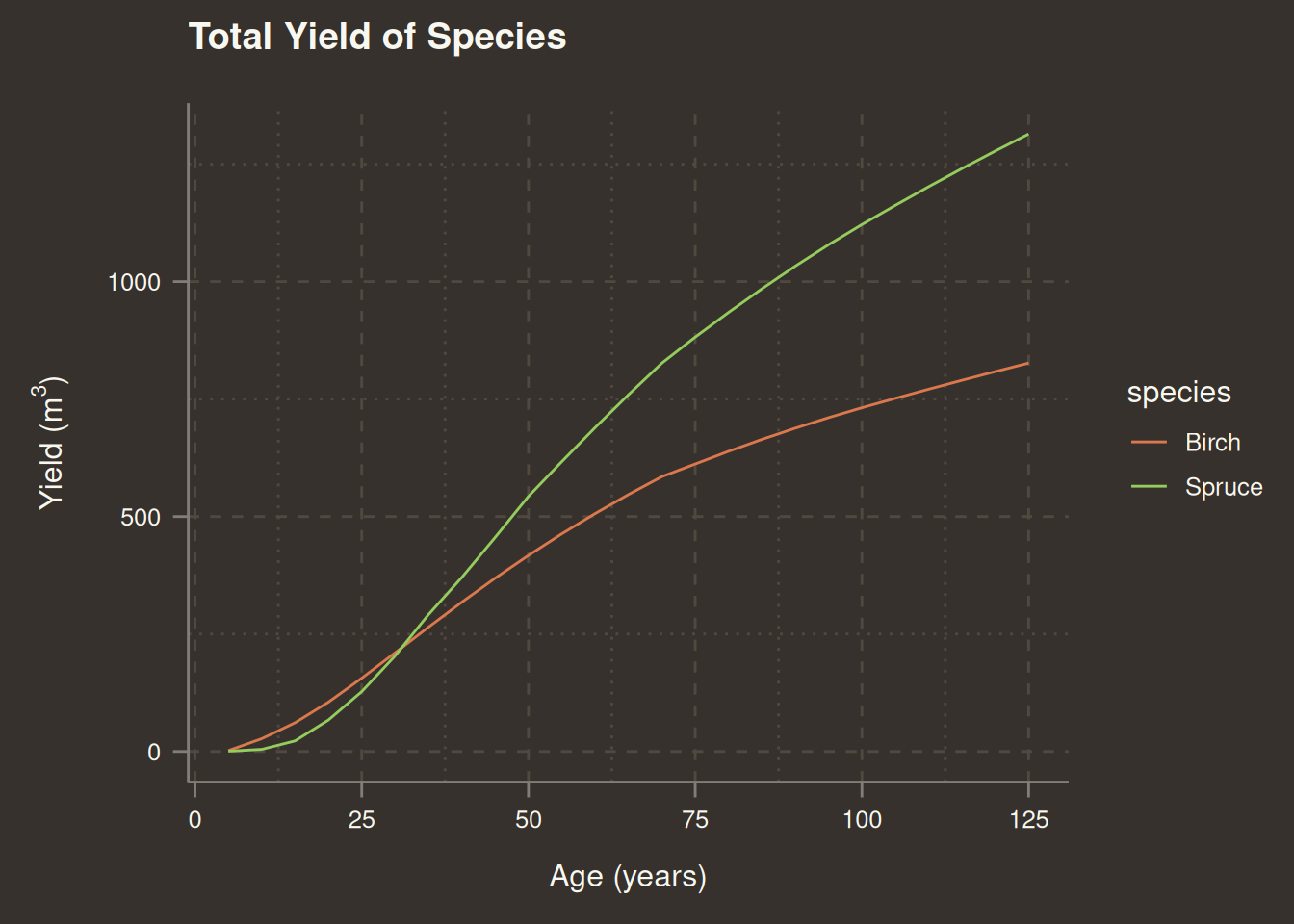
Figure 4 shows that spruce yields more than Birch. This is interesting to see, since it was thinned more times than Birch. Findings like this gives us an insight of the importance of interventions made in the forest.
Show the code
yield_tbl |>ggplot(aes(age, total_yield, col = species)) +geom_line() +labs(x ="Age (years)",y =expression(paste("Yield (", m^{3}, ")")),title ="Total Yield of Species" )
Figure 4: Total yield of the tree species over time. Spruce has more volume than Birch
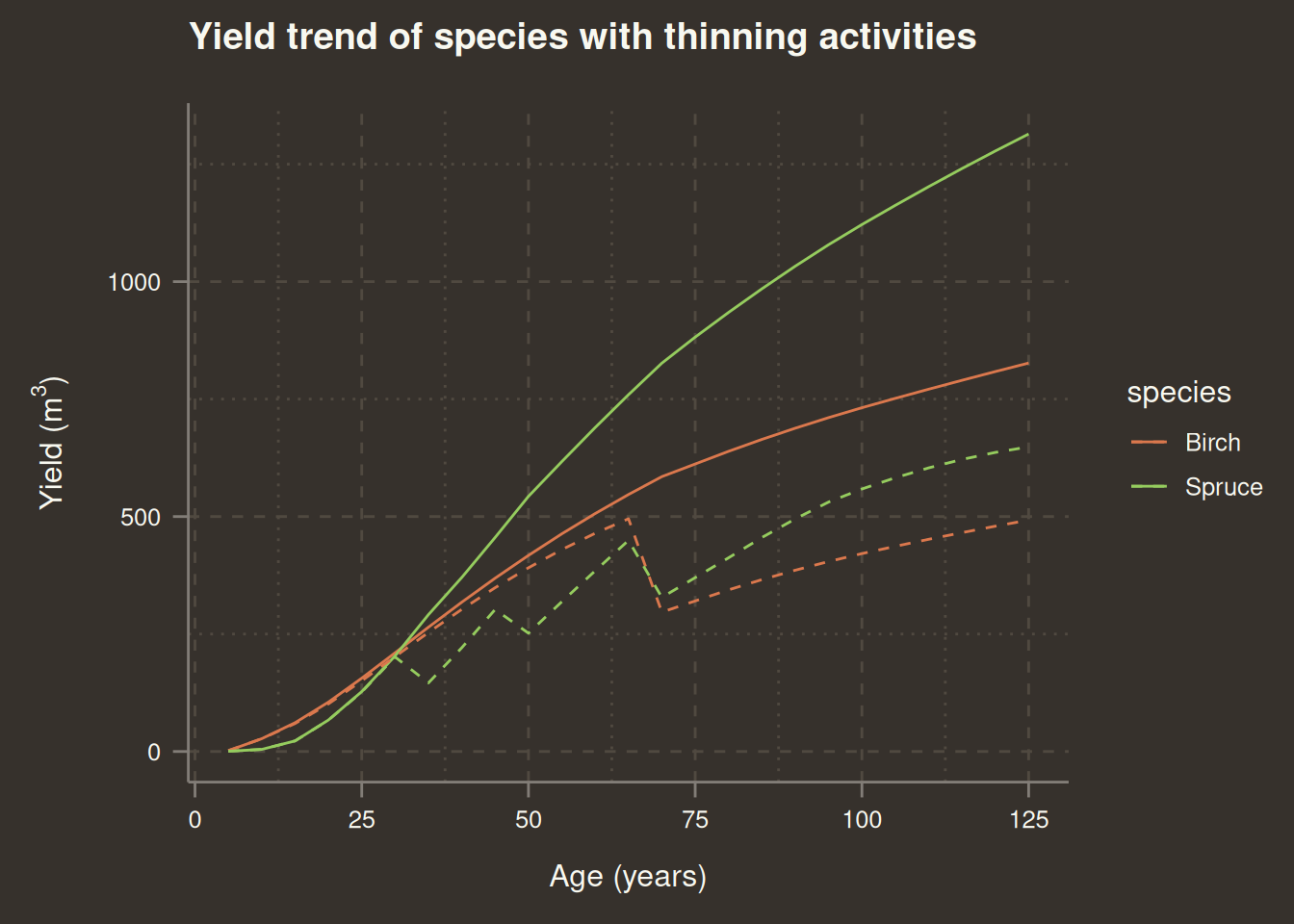
Figure 5 clearly shows this relationship as the yield rate increases for the species after thinning operation.
Show the code
yield_tbl |>ggplot(aes(age, total_yield, col = species) ) +geom_line() +geom_line(aes(age, stand_vol), linetype =2) +labs(x ="Age (years)",y =expression(paste("Yield (", m^{3}, ")")),title ="Yield trend of species with thinning activities" )
Figure 5: Total yield of species and their
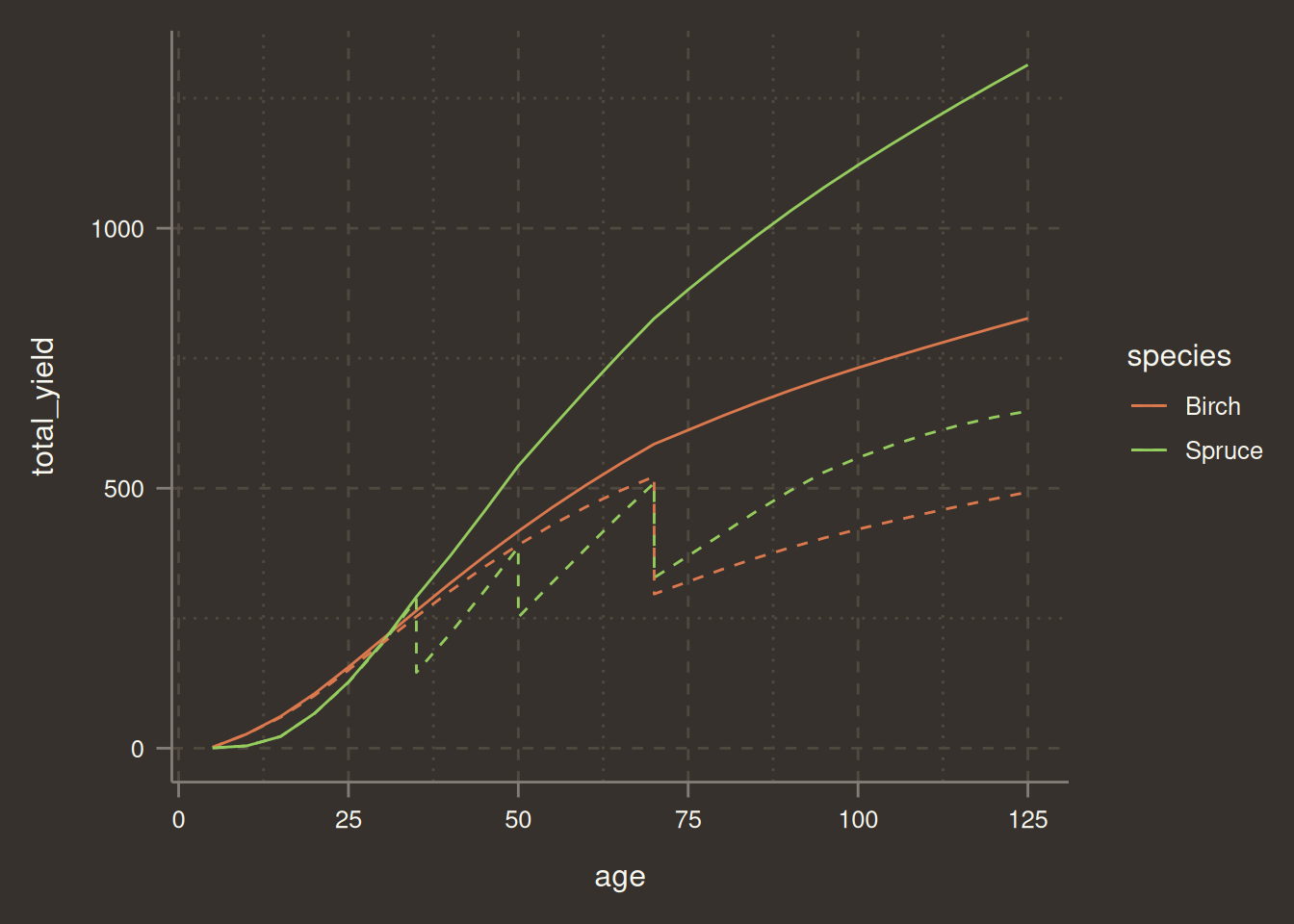
While we have good visuals, Figure 5 can be misleading. What is displayed here is that a thinning operation lasts for more than a year. We will need to correct that, and then we will get a clear read of the thinning intensities.
Correcting the Thinning Age
Usually, the year of harvest or thinning has two volumes and time. The first is the volume before we harvest, and the second is the volume we harvest. They are usually the same, but the time of harvest differs by days or months. Since forestry is a business that involves calculating stand volume over a yearly period of time. It is usually costly and unprofitable to carry out inventory every year; thus, it is carried out between certain periods, 5 to 10 years or more, depending on the management objective and the forest manager’s decision, while we still monitor the stand between such periods. Now we adjust the year of thinning and standing volume to show the age before harvest.
The definition of what is heavy or not is something that varies depending on the parameter used for thinning, viz basal area or stand density, but for simplicity, stand density will be the parameter used to determine the thinning intensity (check ?@fig-std-dens-trend). Based on the stand density or number of trees removed from the stand, thinning ≤ 25% is regarded as light thinning, 50% regarded as moderate, and > 50% is regarded as heavy thinning (Gonçalves, 2021). Using the thinning intensity or degree formula provided by Gonçalves 2021.
\[𝑅𝑁=𝑁𝑟𝑒𝑚/𝑁𝑡\]
Where - Nrem = Number of trees removed - Nt = Total number of trees
Species
Age
Stand density
Thinning intensity
Light or Heavy?
Spruce
35 and 40
1890.1-842.8
55.4% Heavy
Spruce
50 and 55
816.2/517.6
36.6%
Moderate
Spruce
70 and 75
565.9 - 340.9
39.8%
Moderate
Birch
70 - 75
1465.7 - 785.5
46.4%
Moderate
Conclusion
This thinning experiment highlights how management intensity influences stand development and yield. Spruce consistently outperformed Birch in both total volume and cumulative yield, despite undergoing more thinning interventions. The analysis shows that Birch experienced only one moderate thinning, whereas Spruce had three interventions, ranging from heavy to moderate intensity.
These findings emphasize two key insights for forest managers:
Thinning frequency and intensity matter—they can significantly influence long-term productivity without necessarily reducing yield.
Species-specific responses—Spruce demonstrated resilience and sustained growth after multiple thinnings, suggesting it can better capitalize on reduced competition compared to Birch.
Ultimately, thinning is not just a volume-reduction exercise; when planned correctly, it becomes a strategic tool for enhancing stand quality, maximizing yield, and meeting management objectives over time.